

Welcome to a special issue of NPC Observer Monthly, a newsletter about China’s national legislature: the National People’s Congress (NPC) and its Standing Committee (NPCSC).
I’ll start with an important programming update.
I was recently informed that my fellowship at Yale Law School’s Paul Tsai China Center—where I have worked since 2021—will end in July. I’m now in the process of figuring out my next steps.
For this reason, this newsletter will (and, indeed, already has) become more sporadic for the time being. It would be a disservice to both myself and you, the readers, to stick to the original schedule when my mind is and should be elsewhere. As an immediate consequence, I’ve decided to scrap the planned triple issue for Winter 2025–26.
The good news is that I’ve already covered all major NPC-related developments since December 2025 on the main site or elsewhere, including:
the public backlash against a new law that seals the records of minor drug offenses and the legislature’s subsequent response;
the NPCSC Budgetary Affairs Commission’s inaugural report on its review of budgets and fiscal policy measures;
the amended Law on the Standard Spoken and Written Chinese Language;
the results of the legislature’s effort to clean up national laws in 2025, including the quiet repeal of several legacy administrative offenses from the 1990s and the revocation of a 1985 decision delegating taxing authority to the State Council;
the elevation of environmental law into an official branch of Chinese law.
As for NPC Observer’s main site, it is turning ten(!) in October, and I have every intention of keeping it going. At a minimum, it will continue to cover legislative sessions, public consultations, and other major breaking news. This month, for instance, we expect to cover the NPCSC’s 2026 legislative plan (and perhaps its annual oversight plan as well). But it might take us longer to publish our reports. And in-depth analyses and explainers, such as a planned detailed breakdown of the Ecological and Environmental Code, will also be paused for now.
I hope that this will be a short transition period and that I’ll be able to share an update soon. Thank you for your understanding and continued support. —Changhao
In this newsletter, I’ll focus on one of the developments originally planned for the triple issue: the NPCSC’s 2025 report on “recording and review” (R&R) [备案审查]—its mechanism for resolving legislative conflicts that undermine China’s legislative hierarchy. I’ll then offer a preliminary look at the delegate bills submitted during the NPC’s 2026 session. Finally, I’ll end with a preview of the NPCSC’s 2026 legislative agenda.

2025 R&R Report: Stats and Selected Cases
On December 22, 2025, the NPCSC Legislative Affairs Commission (Commission) delivered its annual R&R report to the legislature—a practice dating back to 2017. Among other things, the report disclosed 11 carefully selected cases in which legislation failed review. Here are a few highlights.
Record number of citizen requests for review. In 2025, Chinese citizens and organizations submitted 6,705 requests for review, breaking the record previously set in 2021 (see chart below). The shares of requests submitted online (78.8%) and correctly addressed to the NPCSC (95.0%) also reached historic highs.
Hukou requirement for registering motorized disability tricycles. Chinese law allows motorized, low-speed mobility three-wheelers designed for people with lower-extremity disabilities (officially termed “残疾人机动轮椅车“; click here for an illustration) to operate on public roads. Several cities—including Hangzhou, Fuzhou, Nanning, and Guangzhou—passed laws limiting the use of such vehicles to local hukou holders only.
Those requirements were challenged for flouting the “spirit” of two authorities: the constitutional requirement that “[t]he State and society assist in arranging the work, livelihood, and education of citizens with . . . disabilities,” as well as the statutory protection for “the civic rights and personal dignity of people with disabilities.”
The report didn’t explicitly engage with either argument. Rather, the Commission wrote: “Upon review, we find that motorized disability vehicles are essential to the daily lives of persons with disabilities. Requiring a local hukou to register [such vehicles] creates unnecessary differential treatment in this particular context and constitutes an unreasonable restrictive provision.”
It seems that the Commission invoked some form of equality rationale without naming it in the report. In several prior decisions, it has similarly relied in part on the equality principle to reject hukou-based discrimination in other contexts.
No Shanghai hukou for nonlocals with criminal history. In December 2024, the Shanghai municipal government updated rules governing applications by holders of Shanghai residence permits for a permanent local hukou. One long-standing prerequisite was that the applicant have no criminal record—a provision challenged by citizens. In the report, the Commission concluded:
Upon review, we consider that any restrictive provisions on the rights of persons who have previously been subject to criminal punishment must be genuinely necessary and confined to a specific scope. Where such provisions exceed what is necessary and reasonable, or are overly broad or arbitrary, they are inconsistent with the spirit of the constitutional provision that all citizens are equal before the law. The requirement that applicants for a local hukou have no criminal record lacks a basis in higher-level legislation and is inconsistent with the spirit of the Third Plenum of the 20th Party Central Committee’s call to “establish a system for sealing the records of minor offenses,” thus constituting an unnecessary and unreasonable restrictive provision.
In other words, the Commission seems to have relied on three independent grounds in rejecting Shanghai’s requirement: that it was inconsistent with the constitutional equality principle, lacked a basis in national legislation, and conflicted with a major Party policy decision. Shanghai repealed the requirement in November 2025.
This decision continues the NPCSC’s recent effort to rein in the downstream effects—or “collateral consequences”—of criminal convictions, such as employment restrictions. In its 2024 R&R report, the Commission repudiated local documents that denied certain social welfare benefits to individuals with criminal records or permanently barred them from entering certain professions.
Incorporating advisory local standards into municipal legislation. In March 2025, Chongqing’s municipal legislature revised the city’s rail transit regulations. One provision requires operators to install directional and service signage “in accordance with the relevant . . . municipal standards.” Citizens sought review of this requirement, arguing that local standards may only be nonbinding under the Standardization Law [标准化法].
The Commission concluded that Chongqing’s provision could indeed give rise to the interpretation that the relevant nonbinding local standards had, through local legislation, been effectively rendered mandatory and could therefore serve as the basis for imposing “binding norms.” Short of requesting revisions to the provision, however, the Commission recommended only that Chongqing interpret it consistently with the Standardization Law. (Relatedly, the regulations prescribe no penalty for violating the signage requirement.)
I think it’s entirely within a local people’s congress’s authority to incorporate by reference a specific version of a particular local standard into local legislation, thereby giving it binding force. But that’s quite different from Chongqing’s blanket incorporation of all local signage standards—present and future. The municipal legislature here essentially delegated lawmaking authority to the relevant municipal agencies—and that was inconsistent with China’s division of legislative authority among state institutions.
Resetting case-closing deadlines after changing parties. An unspecified provincial high court issued a document allowing courts to reset the statutory deadline for resolving civil or administrative cases once new parties are added or existing ones substituted. Citizens successfully challenged this rule.
The Commission explained that, under the Legislation Law [立法法], “litigation systems” [诉讼制度] fall within the national legislature’s exclusive authority, implying that statutory time limits are part of those “systems.” It added that, because no national law allows for restarting the clock in those circumstances, the document at issue “exceeded [the issuing court’s] authority and improperly diminished the lawful rights and interests of litigants.”
It turns out that the court had already repealed the document, but because the repeal was procedurally “irregular,” some lower courts were still applying it. After the Commission’s intervention, the court repealed the document again—this time properly.
2026 Delegate Bills: A First Look
The NPC’s plenary sessions offer its delegates an annual opportunity to introduce “bills” [议案]. A bill must be sponsored by either a delegation or a group of 30 or more delegates, and it calls on the legislature itself to take some action, most often legislative. I’ve written about the procedure for processing delegate bills and their role in lawmaking here.
Last month, the NPCSC released a list of the bills introduced this year. For each bill, we now know its title, lead sponsor, and total number of sponsors. (For their contents, however, we’ll have to wait until the end of the year, when NPC special committees report their recommended dispositions to the NPCSC.)
Some stats:
Only 226 bills were submitted in March 2026, the fewest in at least two decades (see chart below). Last May, I discussed the phenomenon of dwindling delegate bills during this NPC (2023–) and speculated about the cause (spoiler: it’s probably due to heightened pre-submission quality control). My prior analysis still stands.
Of the 226 bills, 28 were sponsored by delegations and 198 by groups of thirty or more delegates. Three proposed oversight actions, one proposed a quasi-legislative decision supporting pilot development zones in border areas, and the rest proposed legislation.
Of the 222 legislative bills, 101 proposed new laws and 121 suggested amending existing laws. According to the official tally, 53.6% (119) concern projects already listed in the 14th NPCSC’s five-year legislative plan.
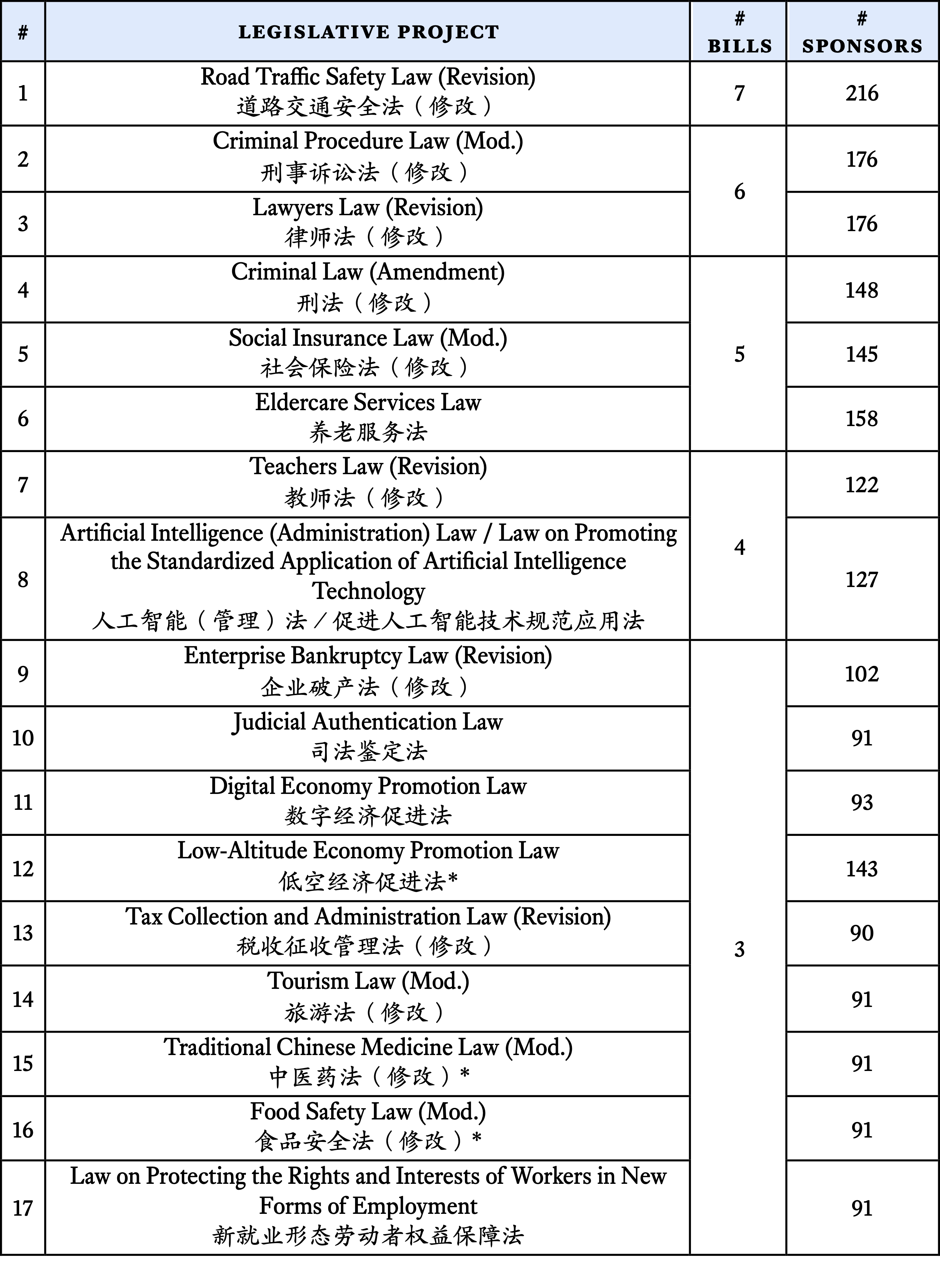
Grouping the bills by the laws they proposed to enact or amend yields 147 legislative projects. A bilingual list is available here. The 17 projects associated with the largest numbers of bills are shown below. Except for the three starred (*) projects, all are already on the NPCSC’s legislative agenda.
2026 Legislative Agenda: A Preview
On April 20, the Council of Chairpersons approved the NPCSC’s 2026 legislative plan (along with several other work documents), and it’s expected to be made public in the coming days. For those who couldn’t wait, a spokesperson provided the following preview at a press conference on April 24:
The 2026 legislative work plan includes 15 bills scheduled for continued deliberation and 19 bills for initial review, along with a number of backup projects. Among them, the Ecological and Environmental Code, the Law on Promoting Ethnic Unity and Progress, and the Law on National Development Plans have already been adopted by the full NPC.
The bills submitted for continued deliberation or initial review include the following:
First, to accelerate the development of a high-standard socialist market economy, the legislature will formulate the Cultivated Land Protection and Quality Improvement Law and the State-Owned Assets Law, and amend the Enterprise Bankruptcy Law, the Trademark Law, the Certified Public Accountants Law, the Law on State-Owned Assets of Enterprises, the Bid Invitation and Bidding Law, the Government Procurement Law, the Pricing Law, the Agriculture Law, and the Tax Collection and Administration Law.
Second, to accelerate financial legislation, it will formulate the Finance Law and the Financial Stability Law, amend the Banking Regulation and Supervision Law and the Law on the People’s Bank of China, and strengthen research and discussion regarding enacting or amending other financial legislation.
Third, to strengthen institutions safeguarding and improving the people’s wellbeing, it will formulate the Social Assistance Law, the Healthcare Security Law, the Childcare Services Law, the National Fire and Rescue Personnel Law, and the Law on Strengthening the Industrial Workforce, and amend the Teachers Law, the Road Traffic Safety Law, and the Urban Real Estate Administration Law.
Fourth, to safeguard and promote social fairness and justice, it will formulate the Procuratorial Public Interest Litigation Law and amend the Prisons Law and the Criminal Procedure Law.
Fifth, to improve the legal framework for ecological and environmental protection, it will formulate the Antarctic Activities and Environmental Protection Law and amend the Water Law and the Renewable Energy Law.
Sixth, to strengthen the development of “foreign-related rule of law,” it will formulate the Law on Countering Transnational Corruption and the Overseas Chinese Rights and Interests Protection Law, while also improving foreign-related provisions in relevant laws.
We’ll cover the work plan in detail once it’s released. In the meantime, you can check out the status of those legislative projects on this page.
That’s all for today’s issue. Thanks for reading!
As a reminder, the NPCSC is seeking public comment on six bills through May 29.
Until I have a better idea of what’s next for me and what sort of publication schedule it will allow, I’ll try to post roundups like this from time to time. Until next time!