

Welcome back to NPC Observer Monthly, a (mostly) monthly newsletter about China’s national legislature: the National People’s Congress (NPC) and its Standing Committee (NPCSC).
This is, unfortunately, not the December (or January) recap you are looking for. The NPCSC’s December session produced a great deal of noteworthy news, but several key legislative records remain unavailable. I’m waiting for their release (hopefully sometime this month) to write about the relevant legislation in a more informed way. In the meantime, I’ve covered two major developments from December—an inaugural report on legislative review of budgets and fiscal policy measures and China’s revised common language law—on the main site. My current plan is to publish a triple issue recapping December, January, and February by the time the NPC convenes on March 5. Thank you for your patience!
If you’re enjoying the newsletter, I hope you’ll share it widely. —Changhao
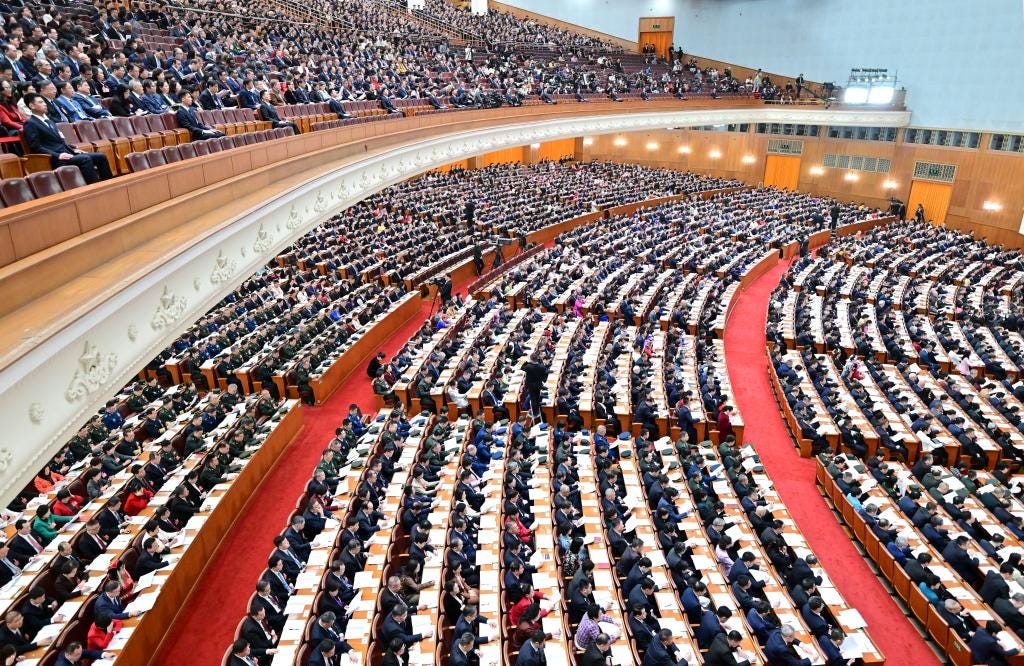
While I wait for the missing legislative records, I thought I’d send out a special issue with updates on selected delegate bills submitted during the NPC’s 2025 session. For background on delegate bills, please check out this explainer or the shorter version here.
In 2025, NPC delegates submitted 268 legislative bills, which were referred to the 10 NPC special committees for deliberations. The committees’ 2025 year-end reports are partially compiled in this PDF.1
As usual, I’ll focus on legislative projects that are not already included in a legislative plan, and won’t discuss recurring proposals that I’ve mentioned before (2023 bills; 2024 bills) but for which last year’s reports provided no meaningful updates, including closely watched legislation like the Artificial Intelligence Law. The following developments disclosed by six of the committee reports caught my attention.
Supervisory and Judicial Affairs Committee
Delegates Qi Xiumin et al. proposed amending the People’s Mediation Law (PML) [人民调解法] to, among other things, include funding for people’s mediation in government budgets, extend the terms of people’s mediation committees to five years (from three), and improve the professionalization and quality of mediators. “People’s mediation” is a voluntary process organized by grassroots people’s mediation committees to settle everyday disputes. The Supreme People’s Court didn’t explicitly support amending the PML but agreed with the bill’s specific proposals. It also pledged to “fully incorporate” those proposals into another legislative project in which it’s involved: a Law on Promoting Diversified Dispute Resolution [矛盾纠纷多元化解促进法]. The Ministry of Justice, for its part, found it “indeed necessary” to amend the PML to reflect current practice and address existing problems. The Committee recommended that the relevant departments coordinate the two legislative projects—drafting the Law on Promoting Diversified Dispute Resolution and amending the PML—and that the latter be included in an annual NPCSC legislative plan at the appropriate time.
Financial and Economic Affairs Committee
Delegates Wang Dongwei et al. proposed amending the Individual Income Tax Law [个人所得税法] to “moderately” lower the top marginal tax rate of 45% to “further attract and retain high-level talent from within and outside China.” The Ministry of Finance (MOF) and the State Taxation Administration (STA) appeared to favor maintaining the status quo. They argued that any adjustment of the tax brackets would “affect tax revenues” and must conform to the “policy direction of . . . reasonably regulating high incomes.” In their review, the current rate of 45% is “appropriate.” The Committee did not seem to disagree. The Communist Party’s 2024 Third Plenum called for income-tax reforms, so the Law might nonetheless be amended soon. Still, China’s highest earners should not expect a substantial tax cut.
Delegates Dong Mingquan et al. proposed enacting a Low-Altitude Economy Promotion Law [低空经济产业促进法]. They argued that specialized, unified national legislation could help China tap into the “enormous market and development space” in the low-altitude economy, which is centered around drones and other airborne devices flying below 1,000 meters. The relevant national regulators agreed with the delegates’ views “in principle,” but pointed out that “the low-altitude economy is overall at a critical stage of transitioning from exploratory application to regulated development and that internationally there is not yet mature experience to draw upon,” suggesting that enacting a comprehensive statute now would be premature. Rather, they would use a variety of legislative forms (including lower-level regulations) to improve the law governing “areas of urgent practical need.” The Committee agreed, adding the formulaic recommendation that the agencies “strengthen research and put forward legislative proposals at the appropriate time.”
Two delegate bills proposed enacting an Estate (and Gift) Tax Law [遗产(和赠与)税法], citing the “increasingly prominent problems of an unreasonable income-distribution structure as well as unbalanced and inadequate development.” They argued that levying an estate tax (or an estate tax together with a gift tax) would promote social equality, increase fiscal revenue and consumer spending, and boost the philanthropy sector. The MOF, the STA, and the NPCSC Budgetary Affairs Commission didn’t reject the proposals outright. Instead, they appear to view the Party’s 2024 Third Plenum decision—particularly, its call to “reform the system of direct taxes” and “improve redistribution mechanisms such as taxation”—as providing policy support for estate and gift taxes. Levying these taxes, they argued, would “prevent excessive concentration of wealth, narrow the wealth gap, and promote social equality,” though they acknowledged that “there are also some difficulties and problems that need to be studied.” The Committee found the delegates’ proposals valuable and recommended further research and analysis, followed by legislative proposals in due course.
Delegates Jiang Chenghua et al. proposed enacting a Law on Countering Foreign Economic Sanctions [反外国经济胁迫法] to enrich China’s “toolbox for external legal struggle, respond to the coercive and bullying practices of Trump 2.0, . . . , unite more countries to hedge against the unilateral bullying by the United States, and resolutely safeguard China’s sovereignty, security, and development interest.” While acknowledging that the proposal aligns with the Party’s emphasis on developing “foreign-related rule of law,” the Ministry of Commerce responded that China had already adopted a combination of countermeasures, indicating that, for now, it would prioritize making use of existing legal tools and pursue additional legislation to counter sanctions, interference, or long-arm jurisdiction only where “urgently needed.” It said it would study the necessity and urgency of passing a Law on Countering Foreign Economic Sanctions, but it doesn’t sound like one would materialize anytime soon.
The Yunnan delegation proposed enacting a Law on the Classified and Graded Protection for Cross-Border Data Flows [数据跨境流动分类分级保护法]. It recommended that the Law “clarify generally applicable standards for identifying the classification and grading of cross-border data flows, standardize the procedures for data classification and grading, while leaving room for specific industries or departments to adopt their own data classification and grading, and providing special protection for data involving children’s privacy and data of special groups.” The National Data Administration and other unnamed departments rejected the proposal, though not in so many words. They vowed to “effectively implement [existing] national policies on the security management of outbound data transfers,” suggesting they didn’t view a new national law as necessary. The Committee concurred.
Delegates Tang Weijian et al. proposed enacting a Data Resource Law [数据资源法] to “regulate data-processing activities, safeguard the lawful rights and interests of participants in the data-factor market, promote the efficient production and circulation of data factor, and support the high-quality development of the digital economy.” The National Data Administration didn’t endorse the idea. It explained that existing policy and institutional arrangements already addressed the bill’s proposals to establish “systems for data property rights, data-trading contracts, open operation of public data, and systematic protection for data resources.” Going forward, its priority would lie in implementing and improving existing policies, though it promised to study the feasibility of a national law. The Committee concurred.
Environmental Protection and Resource Conservation Committee
Delegates Yin Ping et al. proposed enacting a Geological Survey Law [地质调查法] to, among other things, “grant necessary powers related to geological survey, regulate the exercise of such powers, strengthen rights protections, establish systems for the scientific use and regular updating of geological survey data and materials, [and] qualification and credential management.” The Ministry of Natural Resources affirmed the “important pioneering and foundational” role of geological work in economic development and emphasized the need to “intensify geological-survey and mineral-exploration efforts” to implement the Party’s 2024 decision to improve the systems relating to strategic mineral resources. It also disclosed that the China Geological Survey had already drafted a Geological Survey Law. The Committee recommended that the relevant agencies study the bill’s proposals and that the Law be listed in an NPCSC legislative plan when conditions are ripe.
Social Development Affairs Committee
Delegates Cui Ronghua et al. proposed amending the Law on Protecting the Rights and Interests of the Elderly [老年人权益保障法] specifically to designate September 9 as the annual Elderly Caregivers’ Day, citing a shortage of eldercare workers as well as their low social recognition and weak sense of professional honor. The Ministry of Civil Affairs agreed that the Law needs improvement “in the face of the severe trend of population aging in China and the growing needs of the elderly for a better life” and vowed to advocate for amendments when conditions are ripe. But it didn’t sound enthusiastic about establishing an Elderly Caregivers’ Day. Nor did the Ministry of Justice, which was skeptical that such a holiday alone would solve the problems identified by the bill. The Committee agreed that the Law must be amended, while similarly dismissing the bill’s main proposal.
Education, Science, Culture, and Public Health Committee
Three delegate bills proposed amending the Compulsory Education Law [义务教育法] to “increase funding for compulsory education [i.e., Grades 1–9] and extend its duration” to include three years of either preschool or high school. The Committee pointed out that China has been steadily increasing investment to promote “high-quality, balanced development” of compulsory education across the country. It also cited the Party’s call to “explore” lengthening compulsory education in its recommendations for the 15th Five-Year Plan. It therefore urged the relevant departments to “reasonably plan the pathways and methods” for achieving that objective and recommended amending the Law when conditions are ripe.
Agriculture and Rural Affairs Committee
Three delegate bills proposed enacting an Agricultural Insurance Law [农业保险法] to, among other things, “clearly define . . . the special principles and mechanisms of agricultural insurance, improve the fiscal cost-sharing mechanism for agricultural insurance, . . . and refine the regulatory framework for agricultural insurance.” Under governing State Council regulations, agricultural insurance protects farmers against financial losses caused by natural disasters, accidents, pests, and livestock diseases. The Office of the Central Rural Work Leading Group, the Ministry of Finance, and the Ministry of Agriculture and Rural Affairs (MARA) argued that enacting such a law is “very necessary” and that the legislative conditions have matured, recommending that the Committee lead its drafting. The National Financial Regulatory Administration, by contrast, did not believe the timing is yet ripe.
In addition, eight other delegate bills proposed comprehensively revising the Agricultural Mechanization Promotion Law [农业机械化促进法] that has not been meaningfully updated since its enactment in 2004. MARA agreed, believing that the timing for amending the Law is “basically ripe.”
The Committee reported that, after having had conducted extensive field research and consultations with relevant stakeholders, it, too, found both projects necessary. It vowed to “actively push for” the inclusion of legislative projects concerning agricultural protection and promotion in the NPCSC’s 2026 legislative plan.
Besides catching up on recent NPC news, I’m also working on previews for the upcoming #NPC2026, so stay tuned—and subscribe!
The NPCSC will next meet on February 25–26; here’s my preview.
Meanwhile, happy Year of the Horse to all those who celebrate! 🐎🐎🐎
The reports of five committees—Ethnic Affairs; Constitution and Law; Education, Science, Culture, and Public Health; Foreign Affairs; and Agriculture and Rural Affairs—have not yet been published in the NPCSC Gazette but can be viewed at those links. I’ll update the PDF link in the text once these have been formally published. The PDF was updated on February 27 to include all reports. —Ed.